How a digital twin turns everyday plant operation data into audit-ready CSRD and ESG reporting — cutting manual effort and Scope 1-2 reporting risk.

Sustainability reporting has quietly become one of the most expensive administrative burdens in process industry. With the EU’s Corporate Sustainability Reporting Directive (CSRD) phasing in, an estimated 50,000+ companies now fall under its scope — up from roughly 11,700 under the previous regime (European Commission). For most plant operators, the data needed to comply already exists — it’s just trapped in historians, spreadsheets and PDFs. The smart move is to stop treating ESG reporting as a separate project and start treating it as a by-product of digital plant operation.
Manual reporting is slow, error-prone and hard to audit. Companies report that a significant share of sustainability-disclosure effort still goes into collecting and validating data rather than acting on it. Deloitte has noted that data availability and quality remain the top obstacles to CSRD readiness for many organizations (Deloitte).
The friction is structural:
The result: an annual scramble, weak audit trails, and numbers no one fully trusts.

A digital twin built from your plant documentation does something subtle but powerful: it creates a single, structured model of every asset, stream and meter, with their relationships intact. Once your equipment, instruments and process flows are represented as connected data objects — not loose documents — the same model that drives predictive maintenance and operations can also feed sustainability metrics.
Industrial energy is where the stakes are highest. Industry accounts for roughly 38% of total final energy use globally, and the broader industrial sector is responsible for about a quarter of energy-system CO₂ emissions (IEA). Even modest visibility gains translate into measurable carbon and cost reductions. The World Economic Forum has highlighted that digital technologies could help unlock significant emissions reductions across industrial value chains (WEF).
The twin connects to operational data through open standards:

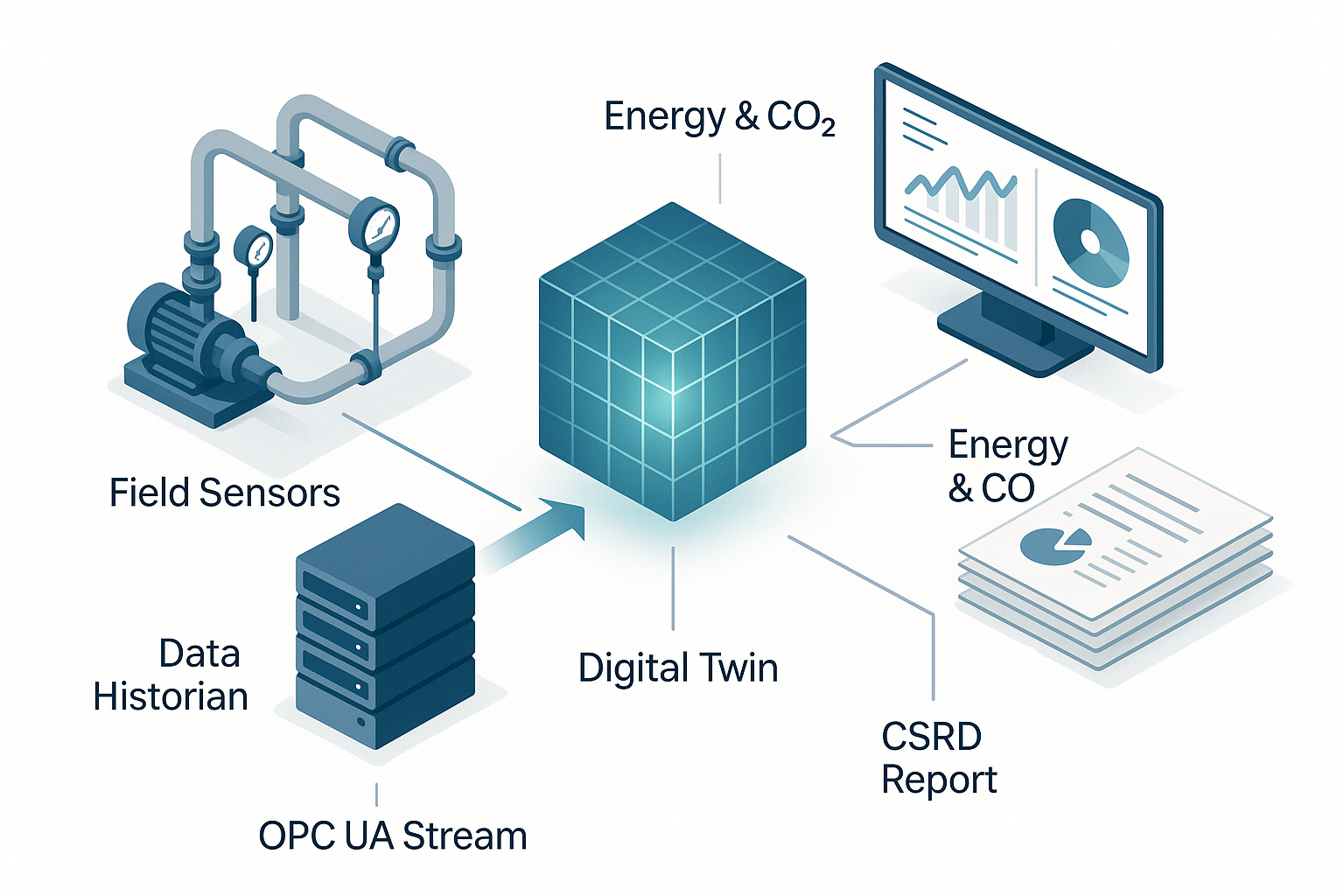
When plant operation is already digital, ESG reporting becomes a query, not a project. Here’s the mechanism:
Energy meters, flow sensors, fuel-gas measurements and emissions monitors stream into the historian via OPC UA. Because the values are timestamped and tied to a specific asset in the twin, they carry context automatically — which boiler, which line, which utility.
The twin maps measured quantities to GHG Protocol Scope 1 (direct combustion), Scope 2 (purchased electricity, heat and steam) and the relevant European Sustainability Reporting Standards (ESRS) datapoints. Conversion factors and emission factors are applied transparently, so every reported tonne of CO₂e is traceable back to a meter reading.
Automated checks flag missing data, sensor drift or implausible jumps — the same data-quality discipline that supports predictive maintenance also raises the quality of ESG figures. This matters because CSRD requires limited assurance of sustainability information, moving toward reasonable assurance over time (European Commission). Auditors want lineage, not estimates.
With PlantPilot’s energy & CO₂ analytics, the structured numbers flow into ESG/CSRD-aligned outputs on demand — monthly, quarterly or for the annual disclosure — instead of a year-end data hunt.
This is not magic, and honesty matters:
The compelling part is that the same investment serves two masters. Predictive maintenance and energy optimization already justify a digital twin on operational grounds — McKinsey research has long associated predictive-maintenance and digital approaches with material maintenance-cost and downtime reductions in industrial settings (McKinsey). When CSRD reporting rides on top of that same model, the marginal cost of compliance collapses.
Concretely, operators that digitize plant operation gain:
For EPCs and engineering companies, this reframes the deliverable: a well-structured digital twin handed over at commissioning is also a head start on the operator’s CSRD obligations — a genuine differentiator. Explore how this plays out across different process industries.
CSRD and ESG reporting do not have to be a parallel universe of spreadsheets and consultants. If your plant is already operated digitally — sensors flowing through OPC UA into a historian, assets modeled in a digital twin — then sustainability disclosure becomes a structured output you can generate on demand. Build the twin once for operations and predictive maintenance, and let audit-ready CSRD reporting fall out as the by-product. That’s the difference between chasing compliance every year and simply having it.
Get a demo and an individual version of PlantPilot to run your plant operation — saving money, time and emissions. Whether you build plants or operate them: establish a future-ready service business at a fingertip and run your plant smarter.
Get in contact

 Deutsch (DE)